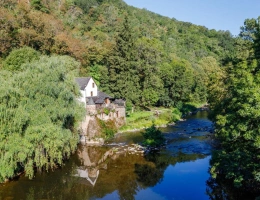
A mill for sale in Tarn (81) is most often found on the Tarn river itself, around Albi and Gaillac, or on the Agout and the Thoré near Castres and Mazamet, an area where water long served the textile industry as much as milling. On this page, ma-propriete.fr brings together the mills for sale in Tarn: former watermills to renovate, converted mill-factories, and riverside flour mills. This dual heritage, farming and industrial, still shows in the architecture of the buildings offered for sale.
You will also find price benchmarks based on actual sales, an overview of where these properties are concentrated, and the points to check before buying a mill, particularly on former industrial sites where the scale of the buildings can be a challenge as much as an asset. To prepare your project, read our white paper on creating a rural gîte, whose advice applies fully to a Tarn mill.
There are no official statistics dedicated to mills: sales are too rare and too varied (a ruin to restore, a habitable mill, a flour mill with a turbine). The most reliable market benchmark remains the price of country houses, which a habitable mill resembles, with a premium for the water, the character and the water rights, and a discount for the work required.
How much does a country house cost in Tarn (81)? According to DVF data (notarised sales) analysed by the ma-propriete.fr observatory, the median price of a country house in Tarn (81) stood at €193,000 in 2025, with an average price of €194,538 and a median price of €1,799/m² of living space (1,018 house sales in rural municipalities over the year). The price range is wide: 10% of houses sold for less than €97,000 (floor price, 1st decile) and 10% for more than €290,000 (ceiling price, 9th decile). The typical country house here offers 113 m² of living space on an average plot of 4,540 m², i.e. around 0.5 ha.
This market is below the regional median (Occitanie: €210,000) and close to the national median (€189,200). Since the second half of 2020, the median price has risen from €175,000 to €193,000, i.e. +10.3%; over one year (2024-2025) the change is +6.3%.
| 2025 indicator | Tarn | Occitanie | France |
|---|---|---|---|
| Median price | €193,000 | €210,000 | €189,200 |
| Average price | €194,538 | €220,462 | €207,100 |
| Floor price (1st decile) | €97,000 | €107,500 | €90,000 |
| Ceiling price (9th decile) | €290,000 | €347,000 | €340,000 |
| Median price per m² of living space | €1,799/m² | €1,987/m² | €1,830/m² |
| Average living space | 113 m² | 111 m² | 108 m² |
| Average plot size | 4,540 m² | 4,162 m² | 3,181 m² |
| Number of sales in 2025 | 1,018 | 14,163 | 150,313 |
A departmental average hides large gaps. A smallholding to renovate, a restored longère with its outbuildings, a farmhouse on several hectares of land or a manor house with parkland do not sell at the same price, and the location matters as much as the building: coastline, tourist area, peri-urban countryside close to a job market or deep countryside. The table below shows the median price of country houses in Tarn (81) by type of municipality (cumulative sales from mid-2020 to 2025) and its change between 2021 and 2025.
| Type of municipality | Median price 2020-2025 | Median price per m² | Change 2021-2025 | Sales 2020-2025 |
|---|---|---|---|---|
| Inland tourist areas (hinterland, mountains) | €130,000 | €1,319/m² | +8.2% | 686 |
| Peri-urban countryside (city catchment area) | €200,000 | €1,849/m² | +2.8% | 4,402 |
| Deep countryside (outside urban influence) | €177,500 | €1,667/m² | +0.5% | 1,921 |
These benchmarks help you assess a listing, estimate a property before putting it up for sale, or set your budget for a holiday home or a permanent move to the French countryside. To go further, see our observatory of country house prices in France (national, regional and departmental analysis, downloadable annual report) and work out the full cost of your purchase, including French notary fees, with our notary fees calculator.
The Tarn, between Albi and Gaillac, carried numerous watermills and flour mills, some tied to the fisheries of Albi's pink-brick riverfront and its former woad river trade. The Agout and the Thoré, at the foot of the Montagne Noire near Castres and Mazamet, mainly carried fulling mills and workshops linked to wool-cloth and delaining, some of which still stand out for their large industrial openings and brick chimneys. The Dadou, near Lautrec and Graulhet, and the Sor, complete this network of hard-working southern Tarn rivers.
On the drier plains and causses of the southern part of the department, near Réalmont or the Ségala area, watermills are scarcer, and windmills, only occasional, are practically anecdotal in the Tarn, as the local geography does not favour them the way the neighbouring Lauragais does.
The Gaillac vineyard and the banks of the Tarn around Albi offer the best balance of heritage, land and access, with a market underpinned by wine tourism and the reputation of Albi, a UNESCO World Heritage city. The Castres and Mazamet basin, on the Agout and the Thoré, offers more mill-factories to convert, close to the Montagne Noire and its forests. Towards Lavaur and Graulhet in the west, lowland mills sit closer to the Toulouse conurbation and its residential demand.
The areas closest to Albi and the Gaillac vineyard are more sought after and sell above the departmental average. The Ségala area and the rural cantons around Réalmont remain the most accessible for a mill to renovate, with a wider choice of properties.
Check the water rights attached to the mill (fondé en titre or holding an authorisation), the condition of the millrace, the weir and sluice gates, and the ecological-continuity obligations on the classified Tarn and Agout rivers, closely monitored by the water authorities. A small hydroelectric turbine project remains possible on some sites, especially former mill-factories already equipped with a water drop, but needs a serious prior technical study.
On the building, often in local brick and stone depending on the area, check for damp, flood zoning along the riverbank, and the condition of the outbuildings or former workshops, sometimes sizeable and requiring a significant heating and insulation upgrade. These spaces suit a gîte project well, as the Albi region is a well-established tourist destination all year round.
On ma-propriete.fr, mill listings in Tarn are published by private sellers, estate agents and notaries. Filter by budget, living space and land area, set up an email alert to be told of new listings, and browse all mills for sale in Occitanie if your search extends beyond the department.