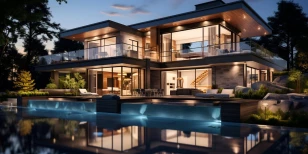
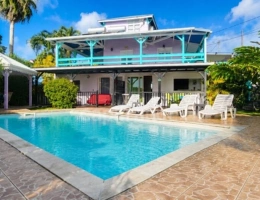
A maison de maître for sale in Martinique first calls to mind the great sugar-cane estates: a two-storey house, white or ochre, whose gallery and ceremonial staircase overlook a courtyard, an avenue of palms and, further down, the old distillery. In town, the notables' houses of Fort-de-France and Saint-Pierre combine volcanic stone and timber. This section reaches beyond that heritage, however: it welcomes all the fine residences of the island, contemporary villas with a pool facing the Caribbean Sea or the Atlantic, architect-designed houses and restored Creole mansions, wherever the living space passes 300 m² or the price nears a million euros and the property escapes the chateaux, the manor houses and the historic monuments. Consult here the maisons de maître and fine residences for sale posted by private owners, agencies and Martinican notaries.
Below you will find the types of property found on the island, the areas where buyers settle, the particularities of the buildings and the checks to know before signing. To frame your whole project, rely on our guide to buying prestige property in France.
As of 28 September 2026, the section lists 267 properties in France (the section does not yet have enough listings in Martinique for a reliable calculation) at a median asking price of €978,000 (average €1,520,334); 80% of properties are offered between €485,000 and €2,750,000, for a median living space of 372 m² on 1.0 hectare of land, or €2,864 per m² of living space. These are asking prices, before negotiation; they compare with the actual sale prices in the previous section, which are generally lower.
| Asking price | Listings | Share |
|---|---|---|
| under €500,000 | 33 | 12 % |
| €500,000 to €800,000 | 58 | 22 % |
| €800,000 to €1.2M | 70 | 26 % |
| €1.2M to €2M | 67 | 25 % |
| €2M to €5M | 31 | 12 % |
| over €5M | 8 | 3 % |
Statistics calculated on the listings published in the section on 28 September 2026; they change daily with new listings and withdrawals.
The estates form the backbone of Martinique's heritage: a two-storey main house on a stone base, a surrounding gallery, a hipped roof covered in tile or sheet metal, and outbuildings scattered around a yard where the sugar house, the curing house and the workers' cottages once stood. A few, in the south and on the Atlantic coast, have kept buildings listed as historic monuments, which places works under the opinion of the architect of the Bâtiments de France. In town, the timber house with fretwork stands beside rendered masonry residences. Contemporary villas, in concrete, glass and tropical hardwood, occupy the hillocks overlooking the bays.
The service buildings can still be read in the landscape: an old kitchen, a cistern, a basin, a bread oven, a caretaker's cottage, and grounds planted with breadfruit, mango trees and bougainvillea. In recent properties, the infinity pool, the pool house and covered terraces extend living space outdoors. Many properties keep a stone basin or fountain in the yard, inherited from the days when spring water supplied the house.
The Caribbean south concentrates the upmarket villas: Les Trois-Îlets and Pointe du Bout, Les Anses-d'Arlet, Le Diamant, Sainte-Luce and Sainte-Anne fringe sheltered bays where demand outstrips supply. Around Fort-de-France, Schœlcher, Didier and Case-Pilote attract those who want a large house minutes from services. On the Atlantic side, Le François, Le Robert, La Trinité and the Caravelle peninsula offer former estates and large properties facing the offshore islets; the north, from Sainte-Marie to Grand'Rivière, wetter, remains the most affordable and discreet area.
Aimé Césaire airport, at Le Lamentin, links the island with Paris, and the motorway between Fort-de-France and Le Lamentin serves the centre of the island. Properties that are at once large, old and well located are becoming scarce, which explains the patience buyers need. Sales are often negotiated by word of mouth, before any advertisement is published.
On a former farming estate, ask the seller about chlordecone contamination of the soil: plots once planted with bananas may be affected, which bears on the use of gardens and vegetable plots. Have the earth analysed before dreaming of an orchard. Titles call for careful reading: joint ownership, inherited from divisions never settled, remains common and suspends a sale as long as a single co-owner is missing. On the shoreline, the coastal strip known as the cinquante pas géométriques belongs to the State domain, and the Loi Littoral limits extensions and rebuilding.
Martinique combines seismic, cyclonic and volcanic risks; Mount Pelée is covered by a prevention plan. Examine the tie-ins of the walls, the anchoring of the roofs and the strength of the openings. Termites settle quickly into the roof timbers and panelling of old houses. For a recent villa, have the validity of the building permits for the pool and extensions confirmed, and ask for the ten-year insurance certificates. A surveyor familiar with tropical construction will read cracks and rust stains more reliably than a visiting generalist.
Private owners, agencies and notaries post their listings on ma-propriete.fr; sort them by living space, view, pool and outbuildings, then schedule an e-mail alert that tells you as soon as a residence matching your criteria appears. If needed, widen your search to the luxury properties for sale in Martinique, without forgetting the nearby agricultural estates and character houses.