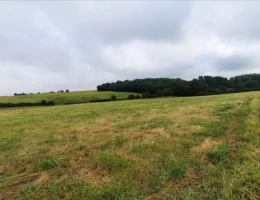

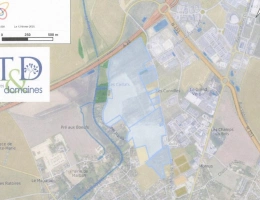
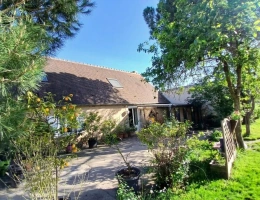
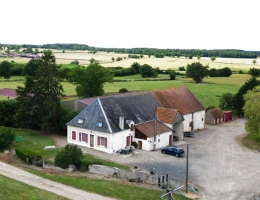
Few French markets still allow a buyer to acquire this much contiguous land for a comparable budget: farms for sale in Indre usually come as a complete unit — farmstead, adjoining fields, sometimes stock and machinery included — because sellers are leaving without a successor and would rather pass on the whole business than break it up. Listings reach us from farmers at the end of their career, from landowning families deciding what to do with an estate let for generations, from rural agencies in the Berry and from notaries. Each states the area, the soil type, what is vacant and what is let, the capacity of the buildings and the share under grass. They sit alongside the rest of our farms for sale in France.
Two properties rarely compare on their own terms, and this page supplies the yardsticks a listing omits: what land is worth depending on whether it lies on the arable plain or in the bocage, which productions support the department, where area is released and which approvals to anticipate. Our white paper « Créer une exploitation agricole » (in French) suits projects still at the thinking stage.
Land forms the base of a farm's value. DVF, the property sales database published by the French tax administration (vineyards excluded), records a 2025 median of €4,500 per hectare in Indre (36), an average of €5,116 and 249 sales; four transactions in five fall between €2,666 and €9,146, against a national median of €5,307.
The SAFER land value benchmark sets €5,730 per hectare for vacant land and pasture offered for sale in the same year, +2.1% over one year and +23.0% over ten, against €6,460 nationally. Land sold with a tenancy in place is valued at €4,770, a discount of about 17%.
Against the Centre-Val de Loire region, whose median is €5,480 per hectare, this department sits 18% lower. For commune-level detail and comparisons with neighbouring areas, see our land price observatory, then cost your purchase with our financial calculators.
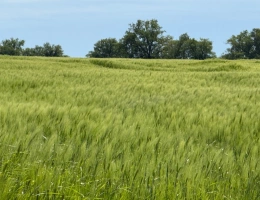
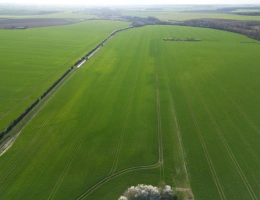
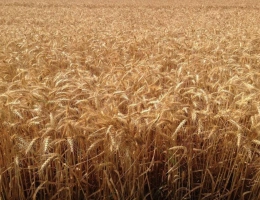
The Champagne berrichonne carries large arable holdings on shallow limestone soils, with wheat, barley, oilseed rape, sunflower and a recognised place for green lentils and pulses. The south and west follow an entirely different logic: the Boischaut is suckler country, Charolais and Limousin, backed by some of the region's most numerous sheep flocks and by goat herds whose cheeses carry well-known appellations, alongside beef cattle units. Between the two, mixed farming remains the usual pattern of family-scale structures.
That geography dictates what is actually being bought. In the north, value sits in the field pattern, soil potential and harvesting machinery; buildings count for little. In the south, it shifts towards pasture, fencing, water points, housing and the quality of the herd, whose genetics and health record deserve an appraisal separate from the land. Always ask what share of the area can be mown, since that decides forage self-sufficiency.
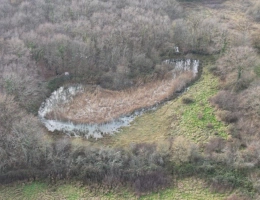
Around Issoudun, Levroux and Vatan, the Champagne berrichonne lines up the largest structures and the firmest prices in the department; land released there generally goes to a neighbour expanding. The Boischaut Nord, towards Valençay and Écueillé, combines crops, woodland and goat units on flinty clays. The Brenne, west of Le Blanc and around Mézières-en-Brenne, is a country of its own: a mosaic of ponds, heath and wet meadows where extensive grazing sits alongside fish farming and shooting.
The Boischaut Sud, from La Châtre to the edge of the Marche, offers the densest bocage and the most affordable entry prices: this is where a working farm can still be bought complete, with its buildings and its adjoining pasture. Together with the Brenne, it is the district where supply renews most steadily, retirements there not always finding a taker. The Indre and Creuse valleys add a few forage-based properties on more broken parcels.
In the Brenne, a large share of the land falls within European protection areas and the regional nature park: pond upkeep, draining down, field drainage, ploughing up pasture and works on wetland habitats are all regulated, and a management plan may be attached to the property. Elsewhere the constraint is more about irrigation water in the valleys and nitrate vulnerable zone status on the cropped districts. Have the rules that apply field by field spelled out before making an offer.
The rest is general rural law, better understood before committing. Told of the transfer, SAFER may use its pre-emption, which it directs first towards those setting up in farming. Working the ground then calls for an administrative consent whose thresholds sit in the regional plan and move with the area already held. A running farm tenancy, finally, follows the land: the tenant stays and holds a priority right to buy, which changes the timetable of a purchase entirely.
Livestock farmers without a successor, arable partners winding up a company, specialist agencies and Berry notaries supply this page throughout the year. In a department this large, settle the farming system and the share of grass you want first; geography comes afterwards. An e-mail alert warns you of matching listings, and sellers can publish a property in a few minutes. To think on a wider scale, browse farms for sale in Centre-Val de Loire.