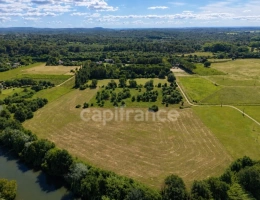
What sets the value of farms for sale in Gard comes down to one thing: water. The department was equipped long ago with canals and pressurised networks that, from the Rhône towards the Costières terraces and the plain, made possible crops unthinkable elsewhere on this coast; a short drive away, the schist Cévennes live on an entirely different agriculture of terraces and chestnut woods. Farmers near retirement, families holding land jointly, specialist agencies and Gard notaries entrust us with their properties: every listing states the areas, the water supply, the plantings in place, the structures and the equipment. They feed into the national record of farms for sale in France.
Underneath the listings sits what they leave unsaid: what land is worth depending on whether it can be irrigated, which productions keep each district alive, where handovers follow one another and which regulatory obligations deserve study. For a first purchase, our white paper « Créer une exploitation agricole » (in French) sets out the steps, from legal form to cash-flow plan.
Land forms the base of a farm's value. DVF, the property sales database published by the French tax administration (vineyards excluded), records a 2025 median of €14,000 per hectare in Gard (30), an average of €13,165 and 39 sales; four transactions in five fall between €6,532 and €20,675, against a national median of €5,307.
The SAFER land value benchmark sets €14,360 per hectare for vacant land and pasture offered for sale in the same year, +8.5% over one year and +48.8% over ten, against €6,460 nationally. SAFER publishes no local figure for let land, too few sales being recorded; nationally, land sold with a farm tenancy in place trades at a discount of about 17%.
Against the Occitanie region, whose median is €7,015 per hectare, this department sits 100% higher. For commune-level detail and comparisons with neighbouring areas, see our land price observatory, then cost your purchase with our financial calculators.
The plain and the stony Costières terraces carry a labour-intensive agriculture: apricot, cherry and apple orchards of the Rhône valley, open-field and protected market gardening towards Beaucaire and Bellegarde, high-value specialist crops, and, in the Gard Camargue, rice growing and bull herds on the salt meadows. Vines, from the Costières to the garrigue, belong to our wine-estate category and do not appear here. In the Cévennes, cheesemaking goat units and sheep flocks occupy the slopes and ridges.
These systems demand neither the same capital nor the same organisation. A lowland holding is bought with its plantings, its tunnels, its packing shed and a seasonal workforce to recruit each year; writing down an orchard depends on the age of the trees and the varieties standing. A working farm in the Cévennes is assessed differently: access, how the terraces carry machinery, its own water resource and the scope for selling locally.
The Costières de Nîmes and the Vistrenque plain hold the most sought-after ground: deep or gravelly soils, irrigation already installed, organised outlets and, in return, expensive land and sharp residential competition around Nîmes. The Uzège and the surrounding garrigue offer drier units, where truffle plantations, olive groves and rough grazing share the limestone plateaux. The Rhône valley, from Bagnols to Beaucaire, remains orchard and early-vegetable country, with fragmented parcels and holdings often scattered across several sites.
West and north, the Gard Cévennes, the Vallée Borgne and the foothills towards Le Vigan and Alès offer modest areas at low entry prices, with mechanisation limited by the gradient. The Gard Camargue combines large units, salinity constraints and dense regulation. Steady supply lies inland; the irrigated districts of the plain generate few sales and many applicants.
A property here is checked first through its access to water: connection to a pressurised collective network, a direct intake, a properly declared borehole, the volume subscribed, the cost per cubic metre and the record of summer restrictions. An orchard or a vegetable block without a secure supply does not have the working value of an equipped parcel, even an adjoining one. Inspect the irrigation equipment too, since replacing it weighs heavily on a purchase plan.
Then the procedures: SAFER, informed by the notary's office, may step in as buyer ahead of the candidate; approval to farm is granted in application of the regional plan; the tenant keeps priority over the parcels he rents. Add the local specifics: nitrate-vulnerable-zone status over the lowland aquifers, flood risk prevention plans along the gardons and the Rhône, the regimes applying to livestock buildings and environmental protection in wetland areas.
Good files move quickly here and sellers consult several intermediaries: fruit growers giving up, market gardeners scaling back, lowland owners weighing farming against letting. The decisive filter remains the water supply, to be settled before area and budget; an e-mail alert then keeps watch. Sellers can list a property in a few minutes. To widen the search, see farms for sale in Occitanie.